A few years ago, a woman came to me for coaching. She was in her late sixties, and she was not my typical weight loss coaching client. She did not come to me about a dress size or a number on the scale. She came because she was scared.
She had started noticing little things. Getting up off the sofa took two or three tries. Lowering herself onto the toilet, and getting back up again, meant reaching for the wall. Nothing dramatic — just a body that was slowly becoming harder to carry around and manage. And underneath all of it was the fear so many women her age carry and almost never say out loud: Am I losing my independence?
So we got to work. No cleanse. No quick fix. Just the slow, ordinary work of rebuilding her strength, week after week. By about week eight, the everyday things started getting easier. By week twelve, she could get up off the toilet in one try — no wall, no bracing, no second attempt.
That is what strength is really for. Not a jawline. Not a smaller number. It is being able to get up off the sofa, up off the floor, and live in your own body with dignity. Muscle is not vanity. Muscle is independence.
“Ozempic face” and the “Ozempic walk”
I am telling you about her because of two words that have worked their way into how we talk about these medications lately. You have almost certainly heard the first one — the “Ozempic face.” And lately I keep hearing a second one. Some are starting to call it the “Ozempic walk.” Have you heard of them?
What rapid weight loss does to your face
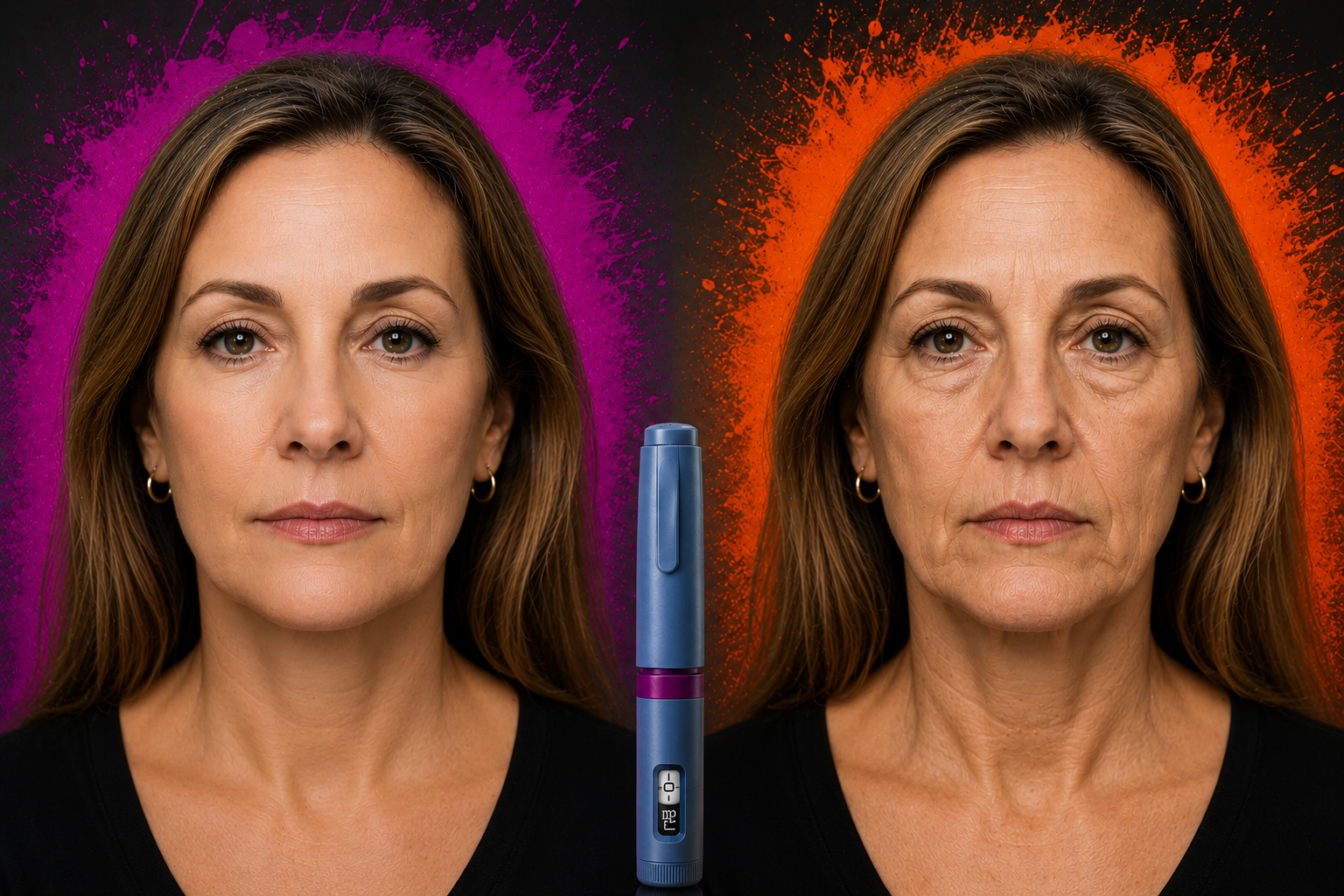
Let me start with the face, because it is the part you can see. When weight comes off this fast, the fat that kept the cheeks full and the skin smooth comes off with it — and the skin cannot keep up. The collagen and elastin that let it bounce back do not have time to catch up. So what is left can look hollow, sunken, older than her years.
And this is not the drug doing something toxic to your face. It is rapid weight loss, plain and simple — the same thing happens after crash diets and after surgery. The drug did not invent this. It just gets women there so fast that the body cannot follow.
The part you cannot see — your muscle
But the face is only the part you can see. The “Ozempic walk” is pointing at something quieter, and honestly, something that matters far more — your muscle. When the weight drops this quickly, a shocking amount of what you lose is not fat at all. The studies put it as high as forty percent — forty percent of the weight gone, and it is muscle. The very strength my client spent twelve weeks rebuilding.
Lose enough of it, fast enough, and you do not just look different. You feel it. You are less steady on your feet. You struggle to get out of a chair. And that is the part that frightens me, because once that muscle is gone, there is no shortcut to getting it back. You rebuild it the slow way, a little at a time, with effort and patience — or you do not rebuild it at all.
It was never the drug. It was the speed. The body was never made to be rushed — and when we try, it shows.
It was never the drug. It was the speed.
And I think, if we are honest, the speed is exactly what makes these medications so hard to resist. You have spent years doing this the slow way and watching the scale barely budge. Of course a shortcut sounds like a gift. I have walked with women for almost forty years who were tired of waiting, tired of wanting their bodies to change — and I have been one of them. So this is not me judging you. This is me loving you enough to tell you the truth: the body keeps the receipts on anything you rush.
There is a proverb I keep coming back to. It was written about money, but read it like it was written about your body:
“Wealth from get-rich-quick schemes quickly disappears; wealth from hard work grows over time.”
Proverbs 13:11 (NLT)
What comes fast tends to leave fast. What is built slowly — the honest way, God’s way — is what stays. God was never against your healing. He is just for the kind that lasts.
Your one thing this week
Pick something your body still does for you that you have stopped even noticing — the stairs, the groceries, getting down on the floor with a grandchild and back up again. Do it on purpose this week. Pay attention. And thank God for the strength that is still yours.
You are not chasing a smaller body. You are honoring a strong one.
And if you are taking a GLP-1, please hear me — none of this is shame. It is just the truth you deserve, so that whatever you decide, you guard the strength that keeps you free. Ask your doctor about your muscle. Eat to protect it. Move to build it. And do not let anything — a shot, a diet, a number — quietly cost you the freedom to live in your own body.
Picture a community of women who measure success differently — not by how small they have gotten, but by how strong they feel and how freely they move. Women who will not trade their independence for a faster result. That is who we are becoming. Not less of ourselves. More.
I want to hear from you. What is one thing your body still does for you that you have stopped noticing? Tell me in the comments — and then go do it on purpose this week.
This is part of an ongoing series on the GLP-1 medications — the good, the bad, and the truth. If you missed the earlier posts, you can catch up here.